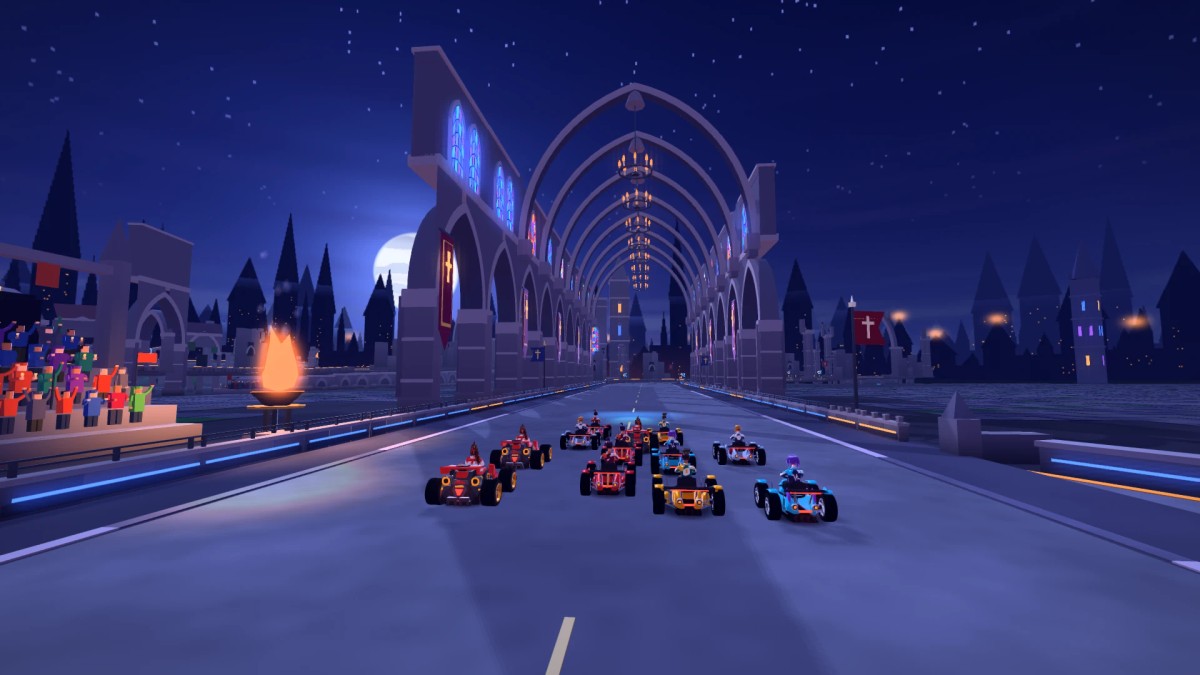
After the noise and aggression of the previous tracks, I wanted the third demo track to feel completely different.
Not just another circuit with a different color palette.
I wanted somewhere that felt old, huge, slightly dangerous, and almost impossible to build a race track through.
So naturally, I built one through a ruined cathedral.
Welcome to Cathedral Circuit.
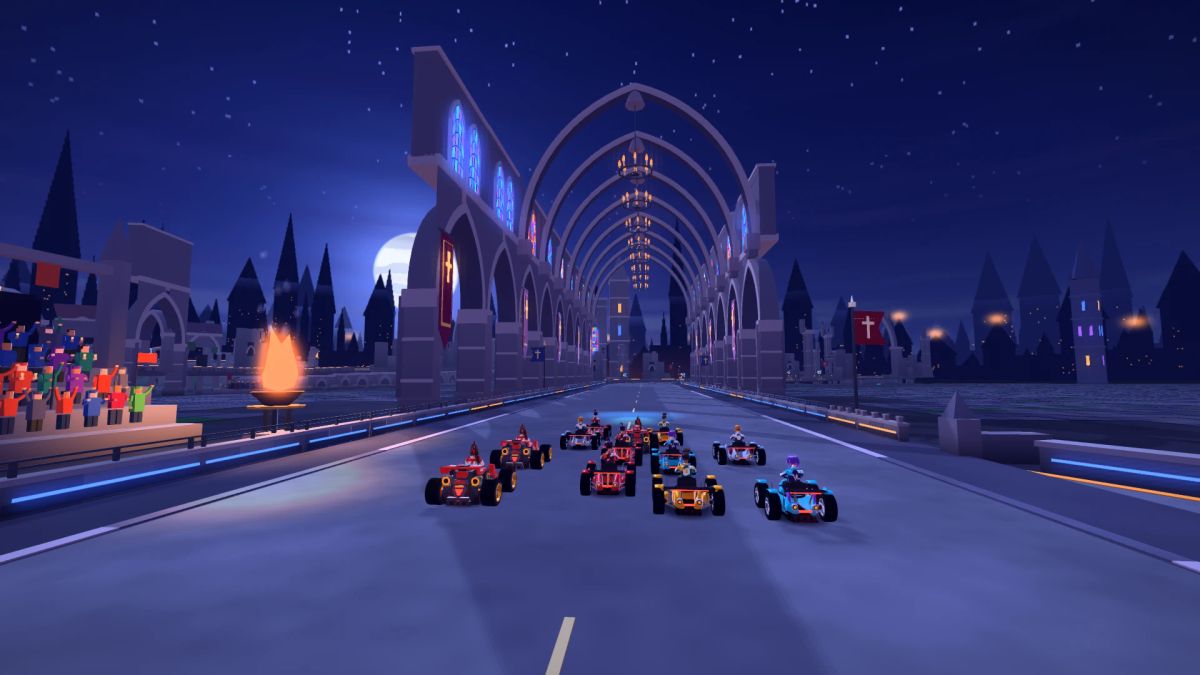
Riff Racers – Cathedral Circuit Track Showcase
By loading the video, content from YouTube will be loaded and data may be transferred to Google/YouTube.
Watch on YouTubeA darker side of Riff Racers
The initial idea was fairly simple:
A race at night, running through the remains of a massive gothic cathedral.
Moonlight through broken arches. Stained glass. Firelight. Old stone. Towers disappearing into the darkness.
But there was one problem I ran into pretty quickly.
Making something dark is easy.
Making something dark and still readable at racing speed is much harder.
Early versions leaned too heavily into black and very dark materials. They looked atmospheric when standing still, but once I actually started driving the track, a lot of the architecture simply disappeared.
Walls blended into the background. Corners became harder to read. Depth was getting lost.
So the final look became much more about contrast than darkness.
Deep blues and muted purples form most of the environment, while fire, stained glass and warmer lighting pick out the important parts of the scene.
The track is still probably the darkest one in Riff Racers so far, but hopefully not in the sense of “I have no idea where I’m going.”
Building a track through the architecture
One thing I really didn’t want was a normal race track with cathedral models placed around it.
The cathedral itself needed to become part of the racing line.
That changed quite a lot about the layout.
The route passes through large interior spaces, ruined side passages, cloisters, elevated sections and broken galleries.
There are moments where you can see another part of the track above or below you, and areas you’ve already driven through appear again from a completely different angle.
That verticality became one of the defining ideas for the track.
The main nave gives the start and finish a large, open space, while other sections become much tighter and more technical before opening up again around the Grand Apse and Bell Tower.
I wanted the lap to have a rhythm to it rather than throwing something at the player every few seconds.
Fast section.
Technical section.
A moment to look around.
Then something slightly stupid and dangerous.
Which brings me to the shortcuts.
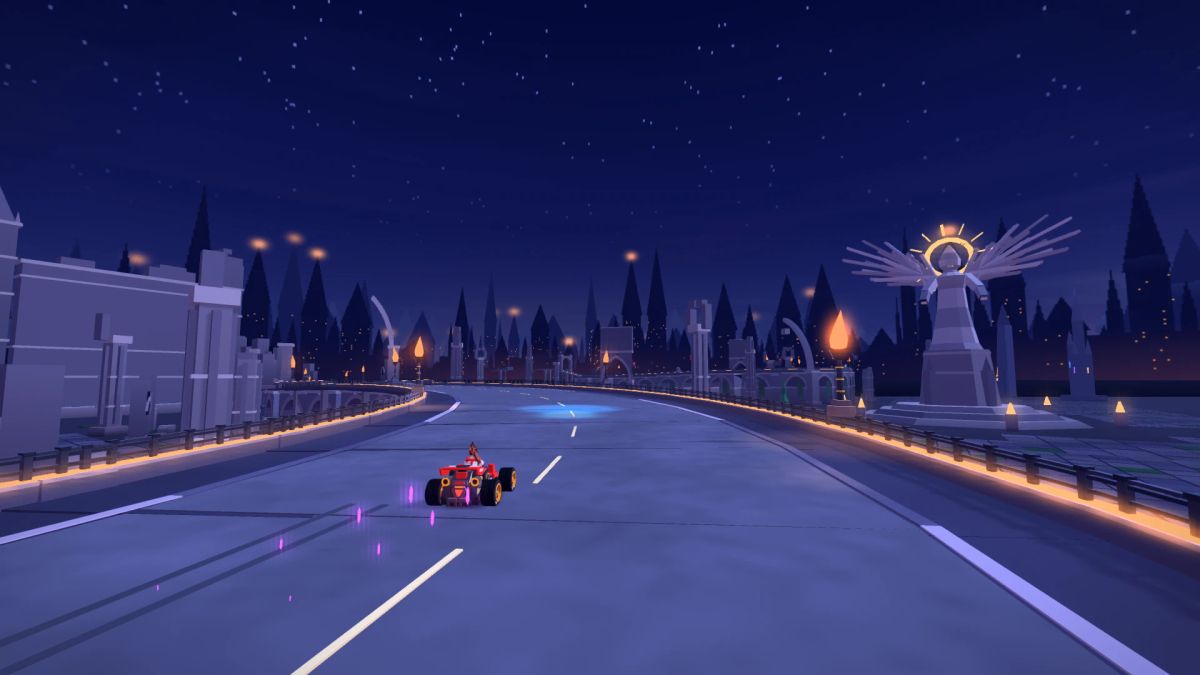
Cathedral Circuit’s Grand Apse became one of the track’s major visual landmarks.
The shortest route isn’t always the easiest one
Cathedral Circuit has several places where the fastest racing line isn’t necessarily the safest one.
One of the main shortcuts runs through the cloister.
The normal route gives you more room and a cleaner line. The shortcut is shorter, but the entry is tighter and there is considerably less space to fix a mistake once you’ve committed to it.
There is also a more dangerous route through one of the ruined upper sections.
That one asks a bit more from the player and includes a jump through part of the broken architecture.
Something I spent quite a bit of time on here was making the shortcuts feel like they actually belonged to the building.
Earlier versions sometimes had the classic game-level problem of:
road → random ramp → congratulations, this is apparently a shortcut now.
It worked mechanically, but it looked wrong.
So a lot of the later work was about making these routes grow naturally out of the environment.
An old corridor continues where the main route turns away.
A damaged gallery becomes an alternative line.
A collapsed floor gradually turns into a ramp instead of suddenly placing one in the middle of the road.
Small things, but they make a surprisingly big difference.
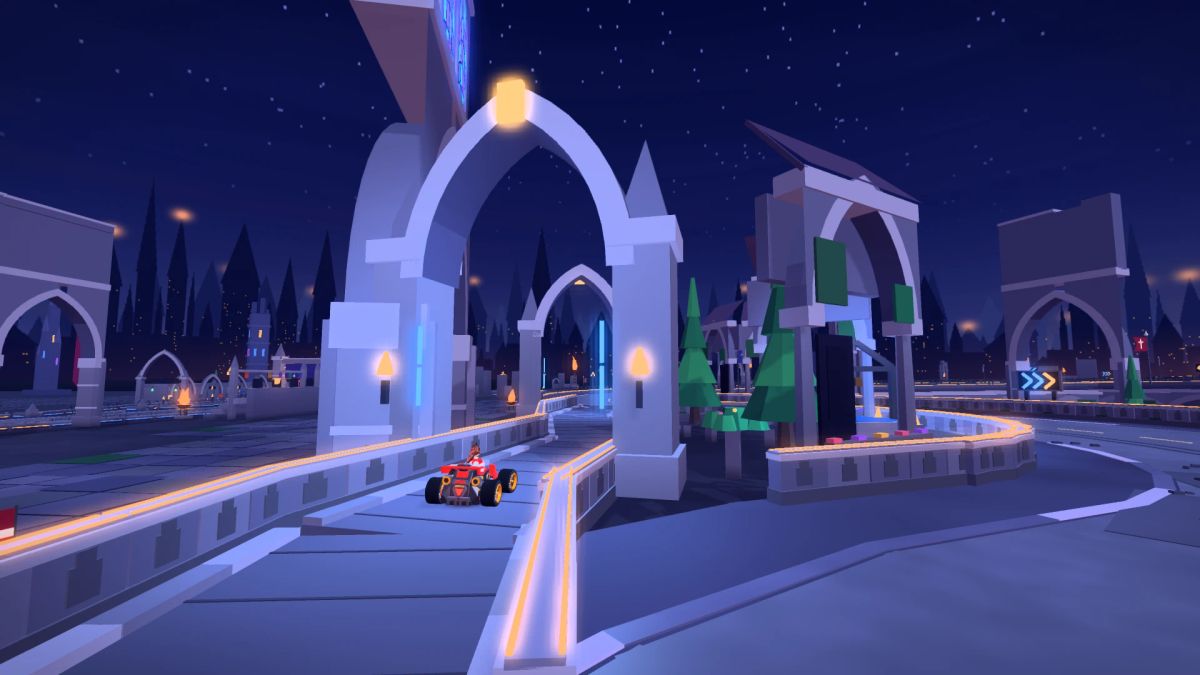
The cloister offers a tighter, riskier alternative to the main racing line.
And yes, there are jumps
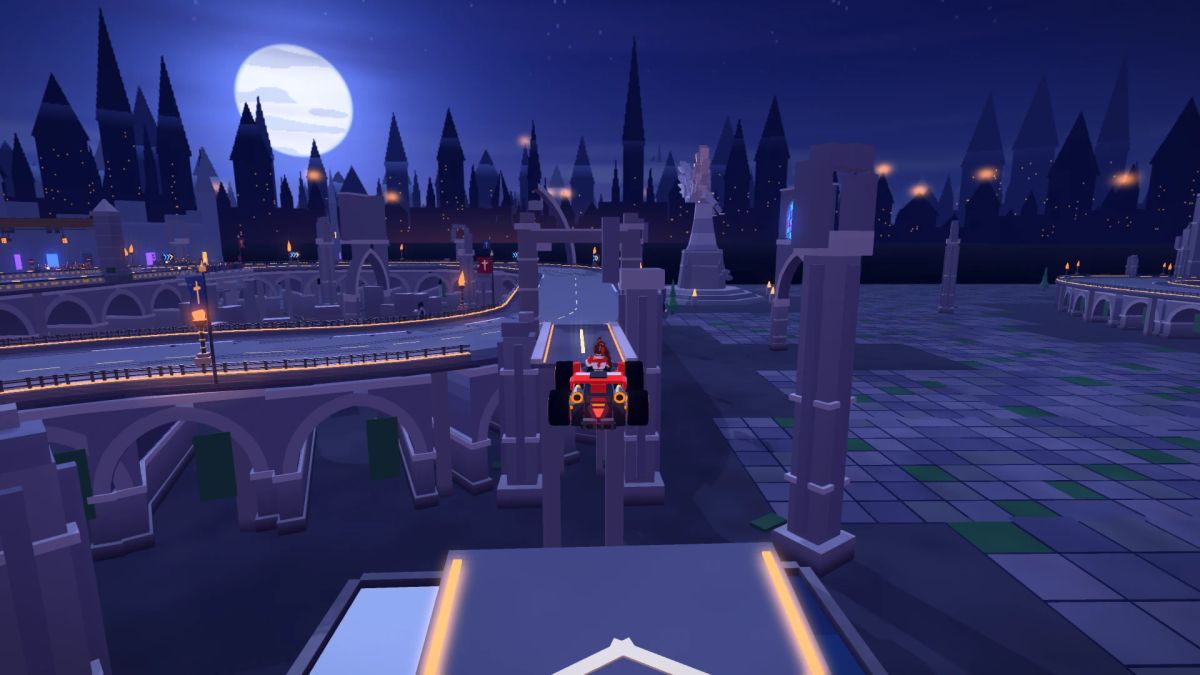
There are two larger jump moments on the circuit.
The first crosses a ruined gap in the cathedral complex.
The second appears later around the Bell Tower section and is a little less forgiving.
The important part for me wasn’t simply having jumps.
Riff Racers already has enough opportunities to launch a car somewhere it probably shouldn’t be.
The challenge was making the jumps feel like a natural consequence of driving through a collapsing structure.
The road now builds towards them rather than suddenly becoming a ramp.
The landing areas also received quite a bit of attention, because a spectacular jump is considerably less fun when the reward is immediately driving face-first into a wall.
Ask me how I know.
The Bell Tower needed to do something
The Bell Tower became one of my favorite areas of the track.
It’s already one of the stronger visual landmarks, so leaving it as completely static scenery felt like a missed opportunity.
There is now much more movement around that part of the circuit, including the bell mechanism itself.
It also gave me a good place to introduce some environmental danger without turning the entire track into an obstacle course.
That balance was important.
I wanted Cathedral Circuit to have hazards, but I didn’t want every corner to become a timing puzzle.
It’s still a racing game first.
The hazards are there to give certain sections personality and occasionally make you reconsider the line you’re taking.
Not to spend the whole race dodging things falling from the ceiling.
Although, to be fair, some things do fall from the ceiling.
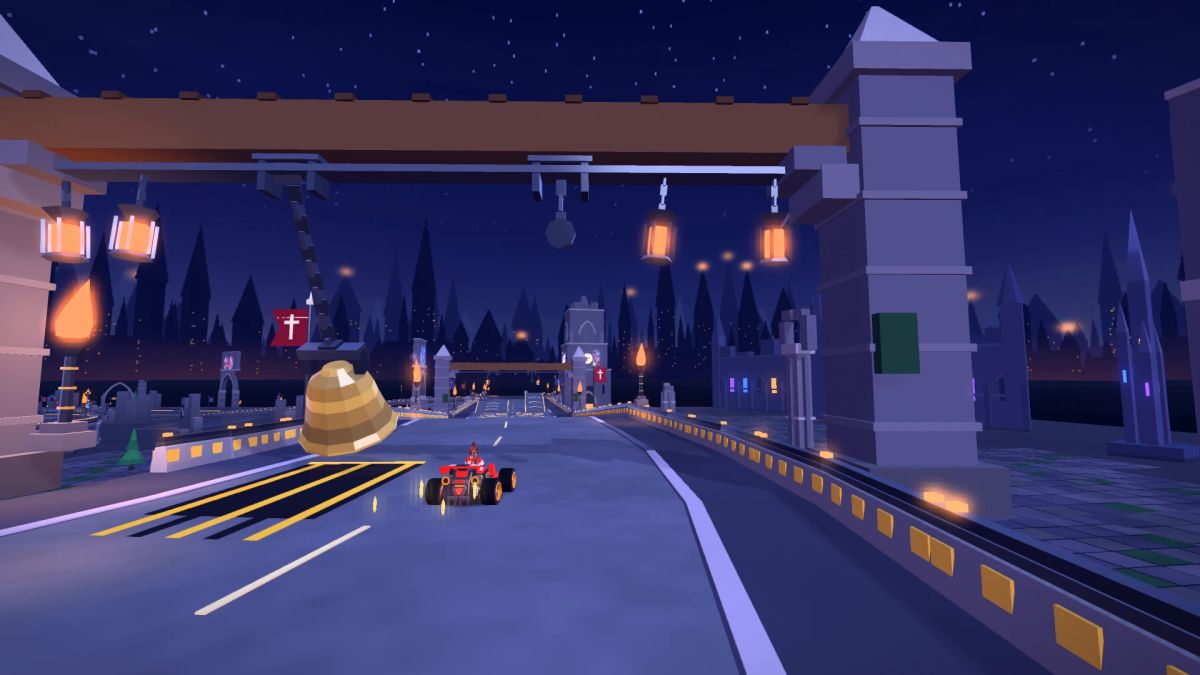
The Bell Tower mixes verticality, movement and one of the track’s environmental hazards.
Making the cathedral feel alive
This was probably one of the biggest changes during the final passes.
A huge environment can look surprisingly dead when everything in it is frozen.
So Cathedral Circuit now has a lot more subtle movement in the background.
Banners move.
Fire flickers.
Smoke and particles drift through parts of the ruins.
The crowd has more variation and movement.
There are people on balconies and around some of the larger spectator areas.
The Bell Tower actually feels like a functioning part of the environment rather than a large static prop.
None of these things are supposed to pull your attention away from driving.
Most of them are details you notice somewhere in the corner of the screen while racing.
But together they help the whole place feel much less like a level loaded into memory and much more like an actual event taking place.
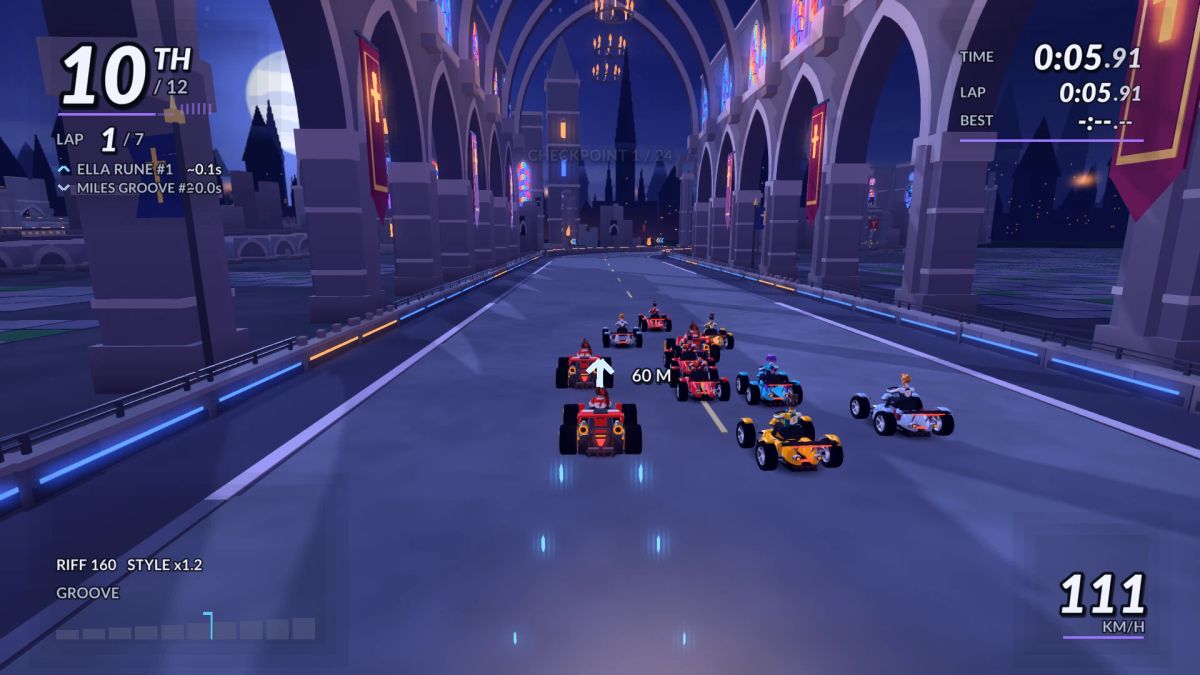
The pit lane is part of the track now
Another thing I wanted to account for early was the pit lane.
Even though not every pit-related gameplay system is necessarily doing something dramatic yet, I didn’t want to reach the point later where the game suddenly needed a pit lane and there was nowhere sensible to put one.
So Cathedral Circuit has one built into the architecture from the start.
Rather than simply placing a second strip of asphalt next to the main straight, it runs through a section that feels like it could genuinely have been repurposed for the event.
The entry and exit were also designed as proper transitions instead of hard branches from the racing line.
It’s one of those things that probably won’t be the first feature anyone notices in a screenshot, but it makes the track much easier to build on later.
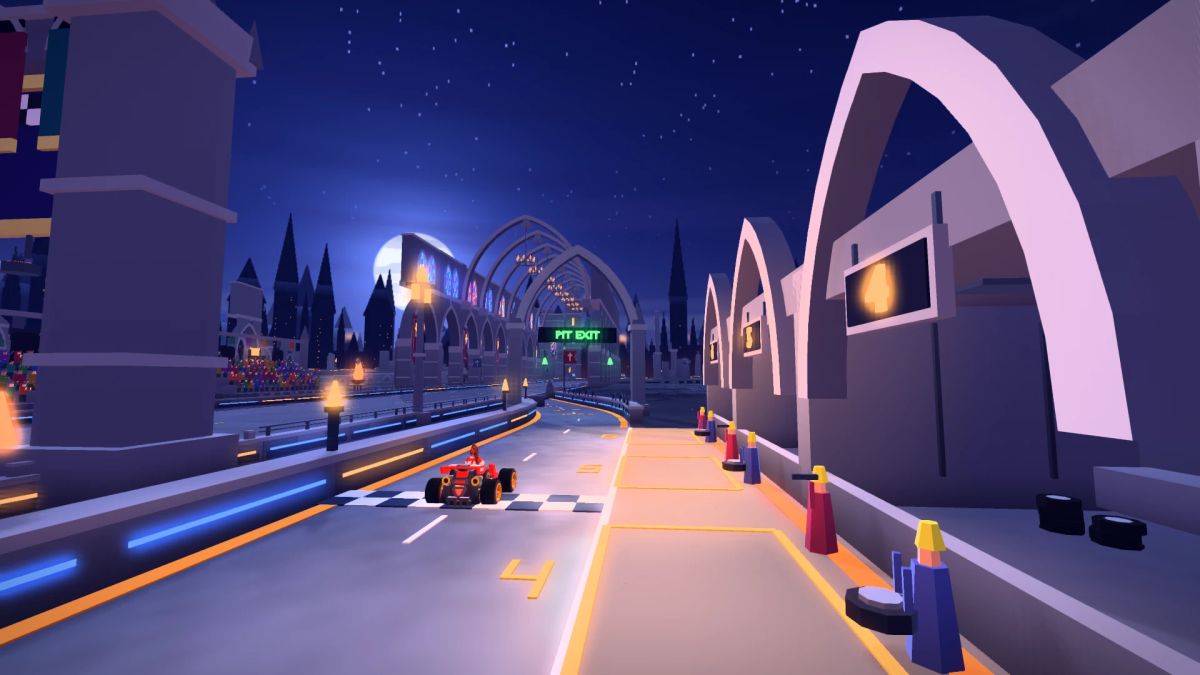
The pit lane is built into the cathedral’s architecture.
Then came the unglamorous part
Once the track looked good, there was still a lot of work left.
And this is the bit screenshots tend not to show.
Driving directly into walls.
Driving into pillars.
Driving into barriers.
Trying to enter shortcuts from completely stupid angles.
Missing jumps on purpose.
Testing the sides of ramps.
Finding objects that looked solid but didn’t actually have collision.
Finding collision where there shouldn’t have been any.
Watching AI drivers discover exciting new ways to become permanently attached to gothic architecture.
A fair amount of the final work on Cathedral Circuit was simply trying to break it.
If something looked solid, it needed to behave like it was solid.
If a shortcut existed, the AI needed to understand it.
If there was a jump, it had to work at more than one exact speed.
If you fell off somewhere, the respawn needed to put you somewhere sensible.
It isn’t the glamorous part of building a track, but it is usually the difference between something that looks finished and something that actually feels finished.
One track, two very different moods
One thing I’m enjoying as the first demo comes together is how different the tracks are becoming.
I don’t want the final set to feel like the same environment with different props.
Cathedral Circuit is slower and more atmospheric in places, more vertical, and more focused on route choice and environmental danger.
It still has the speed and exaggerated arcade feel that Riff Racers is built around, but it expresses that in a very different way.
And that was really the goal.
When you leave one track and load another, I want it to feel like you’ve gone somewhere new.
Three down
With Cathedral Circuit finished, that’s another major piece of the first Riff Racers demo in place.
There are still more tracks to finish, more drivers to work on, and plenty of small things that will inevitably appear once everything starts coming together.
But seeing the environments develop their own identity is probably one of the most satisfying parts of the project so far.
Cathedral Circuit started as:
“What if we race through a giant ruined cathedral at night?”
It ended up becoming one of the more complicated tracks I’ve built for the game.
Which, in retrospect, was probably inevitable.
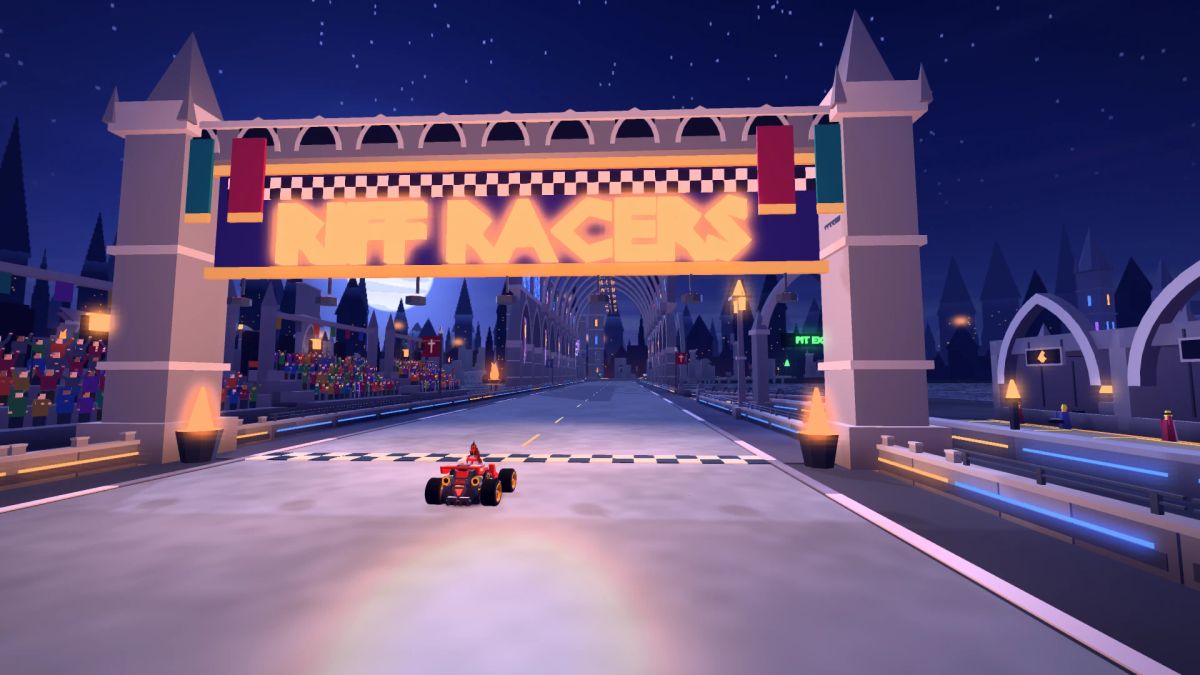
Cathedral Circuit is now complete and will be part of the upcoming Riff Racers demo.
More soon.
— Daniel
BrimFrame